
As the superyacht industry searches for ways to reduce emissions, shipyards are investing in a range of propulsion technologies — from diesel-electric and hybrid systems to methanol, hydrogen fuel cells, and future-ready energy platforms.
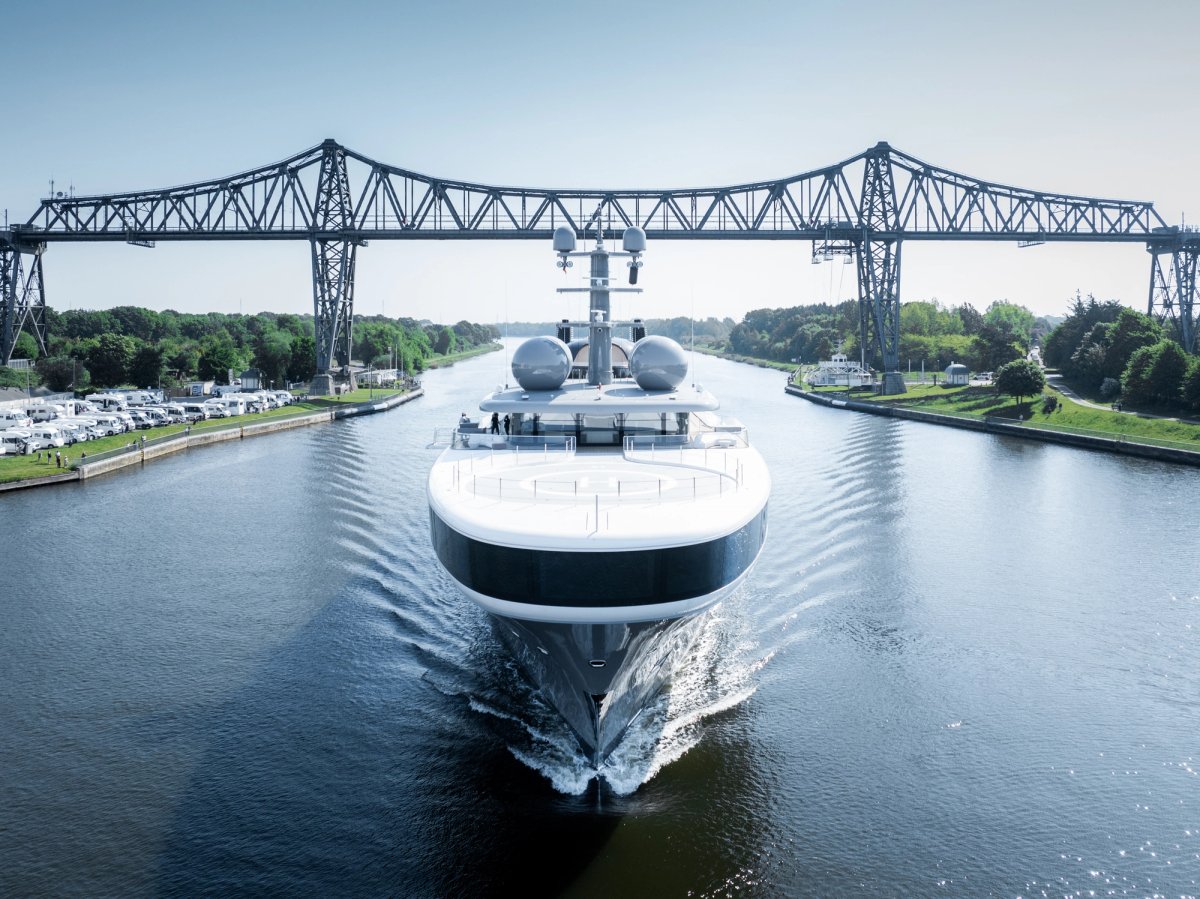
Recent launches highlight just how quickly propulsion technology is evolving. Feadship’s 118.8-meter Breakthrough, launched in 2024 and delivered in 2025, is the first hydrogen fuel-cell superyacht. In hydrogen mode, she is emission-free. Lürssen’s 114.2-meter Nausicaä — formerly Project Cosmos — was launched in 2025 and delivered in 2026; it has diesel-electric propulsion and is equipped with a methanol fuel-cell system that converts methanol into hydrogen to generate electricity. Sanlorenzo’s 50-meter Contigo (formerly Almax) is the first 50Steel model to feature a green methanol fuel cell system for onboard power, with diesel engines for normal navigation. Meanwhile, Bluegame (another Sanlorenzo brand) developed a hydrogen-powered foiling chase boat for the 37th America’s Cup, and Baglietto continues developing its BZero onboard hydrogen-production project.
What yacht owners want
Although shipyards are pursuing different strategies, today’s yacht owner demand is fairly consistent. Lürssen reports growing interest in diesel-electric propulsion, hybrid systems, larger battery banks, and shore power integration.
According to Bram Jongepier, senior specialist at Feadship’s Studio De Voogt, Feadship offers only diesel-electric drives with azimuthing thrusters, with about 90% of its in-build fleet using the system. Feadship calls it the Feadship Advanced Electric Drive, explaining that it consists of electric azimuthing thrusters, a DC bus of 690 to 1,000 volts, a battery bank with a capacity of 1 to 5 MWh, and custom-built variable-speed generators with permanent-magnet alternators. “Due to the setup of the various components, this system is more efficient, more silent, more maintenance-friendly, and more redundant than a conventional shaft line system,” he said.
“At Lürssen, we have witnessed a decisive shift in our clients’ demands toward propulsion systems that harmonize high performance with environmental responsibility,” said Michael Breman, senior sales director at Lürssen. He added that yacht owners today are knowledgeable and expect the latest technology, but they are also mindful of their environmental impact.
Promising alternative fuels or systems
For Feadship, HVO offers the most practical near-term alternative fuel. “HVO is THE short-term solution, enabling 80 to 90% CO2 emission reductions without any significant change to the yacht’s systems,” Jongepier said, explaining that Feadship uses it during trials of its new builds. “It’s really a drop-in alternative,” he added, highlighting its benefits, such as better shelf life, the ability to be mixed with diesel in any ratio, and reduced soot and exhaust odor. However, it’s expensive, hard to source, and users must ensure it’s ISCC-certified.
Both shipyards pointed to methanol as a practical near-term pathway for large yachts. “[It] is adopted by the wider maritime industry as the best compromise on energy density, ease of storage, and risk level,” Jongepier said. Several of Feadship’s new builds include multi-fuel arrangements, allowing them to run on conventional diesel, including HVO, and to switch to methanol. “Once methanol can be carried, this enables the use of highly efficient fuel cells,” he said.
Lürssen also views methanol as a viable solution for superyachts due to its “manageability and synergy” with fuel cell technology. “We believe it provides the optimal mix of technical feasibility and future-proofing for large yachts,” Breman said. Lürssen monitors the alternative fuel landscape, but its decisions are driven by “solutions that are practical, safe, and scalable for large yachts.”
Practical challenges
Alternative propulsion technologies present practical engineering challenges. Fitting thrusters instead of propellers into superyachts often requires changes to design, weight distribution, and structure. There’s a learning curve, Jongepier warned.
Breman agreed that there are hurdles, as with all transformative technology. Space and design integration require new solutions that can affect everything from guest areas to hull layout. “Methanol and hydrogen tanks, for example, require specialized containment,” he said.
Jongepier noted that accommodating alternative fuels can significantly affect yacht design, particularly fuel storage. Methanol, while easier to handle as a liquid fuel, requires considerably more volume than diesel or HVO — approximately 2.5 times more for the same energy output — meaning larger or reconfigured tanks, often within the hull.
Hydrogen, while carbon-free, presents an even greater storage challenge. It requires large cylindrical tanks that must be either cryogenically cooled or highly pressurized, making them difficult to integrate into the hull. As a result, they take up valuable space that could otherwise be used for guest or technical areas.
“The rule of thumb is 2.5 times more volume for methanol, 40 times more for hydrogen for the same amount of energy compared to diesel/HVO,” Jongepier explained. This makes hydrogen suitable for only a limited portion of a yacht’s total energy needs, although it could be a solution in emission-restricted zones or, if infrastructure catches up, for replacing batteries in large-capacity installations.
Storage is also a safety consideration. Jongepier explained that methanol’s low flash point and toxicity require additional safeguards to ensure it can be stored as safely as conventional diesel.
Another factor that inhibits methanol adoption is the lack of dual-fuel engines and fuel cells, he said. “These are in the development phase and will be on the market in a few years, but progress is slower than we’d like it to be,” Jongepier said.
Both Breman and Jongepier highlighted that the global infrastructure for green methanol, hydrogen, and other alternative fuels is not yet ready. At Lürssen, this means they design with both today’s tech and tomorrow’s possibilities in mind. Feadship does the same, preparing for methanol during the build to avoid having to go back in later and remove the lower-deck interior to build cofferdams around the tanks.
Future fuel pricing also remains uncertain. Despite best predictions, renewable production and CO2 taxation are unknown. It’s best to prepare for everything, Jongepier said.
Beyond the technology itself, the industry must also develop training standards and regulations to support these new propulsion systems.
What does the future look like?
Jongepier said Feadship’s long-term roadmap points toward methanol-fueled yachts powered by highly efficient solid oxide fuel cells, with energy-saving propulsion and hotel-load solutions, as reflected in the shipyard’s 2023 83.25-meter Dunes concept. For battery tech, he expects smaller yachts to be fitted out as plug-in hybrids, allowing them to sail 100 to 200 miles on battery power. “Since most trips are very short, this means they will be able to use green shore power for up to 35% of their propulsion energy — similar to current hybrid cars. Shore power should, of course, be developed concurrently.”
“Our approach is to pilot new solutions carefully, ensuring each innovation translates into real-world reliability and uncompromised luxury,” Breman said. “We foresee a period of rapid transition marked by hybrid solutions, gradual adoption of fuel cells, and growing use of truly sustainable fuels.” Lürssen believes hybrid will be the norm, with every new superyacht including a combination of electric and combustion power. He added: “The future will not be defined by a single technology, but by the intelligent integration of multiple systems.”
“As technology and infrastructure mature, methanol and hydrogen fuel cells will begin to serve as both primary and auxiliary energy sources for yachts and hotel systems,” Breman said. AI will also play a growing role in optimizing onboard power management, automatically balancing energy sources to maximize efficiency and reduce emissions.
Nuclear power is a major topic, although Jongepier believes it’s too soon for serious discussion, as international regulations are very new — perhaps in the early thirties. Nuclear is still in its early testing phase, and even if the tech were available, “an individual would not be allowed to own, insure, export (go to sea), or enter just any port with a micro-reactor.”
However, change is constant, and the future is growing more exciting. As Breman said, “We believe the next decade will see the first truly emission-free superyachts — an ambition that aligns with our founder’s vision, but only through continued research, partnerships, and real-world experience.”
Sidebar: Why Power Management MattersRegardless of the energy source, successful alternative propulsion depends on sophisticated electrical integration. Doug Bennis, vice president of sales and marketing at Island Marine Electric, said systems such as hybrid propulsion, battery banks, generators, shore power, and renewable energy sources all rely on advanced power management systems (PMS) to intelligently coordinate electrical generation, distribution, load sharing, synchronization, and power quality.
One of the industry’s biggest challenges, he explained, is integrating multiple power sources and propulsion loads into a single, reliable electrical network. Without intelligent control, vessels can experience instability, inefficient load distribution, unnecessary generator runtime, reduced efficiency, and lower overall system reliability. As a result, “PMS is a critical component of every successful alternative propulsion installation.”
Looking ahead, Bennis expects marine propulsion to continue evolving toward integrated energy management, greater electrification, smarter automation, predictive maintenance, cybersecurity, and remote diagnostics, with control platforms managing a vessel’s entire onboard energy ecosystem.
As Bennis put it, “Ultimately, the future of marine propulsion is not defined by a single fuel or technology — it will be defined by how intelligently every onboard energy source works together.”
Images by Feadship and Lürssen.