
Handling fine art during a yacht refit can be a challenging process.
The boat is heading into a refit, and it requires coordinating many moving parts. Figuring out what to do with the fine art on board is an important element of that process.
“The most important thing is to really plan ahead,” Susan McGregor, founder and CEO of Fort Lauderdale’s Bellissima Fine Art & Services, which handles packing, removing, and storing fine art, said. “It’s not the first thing people think about, but it’s usually the first step in the refit process.”
First, a captain must determine whether the art is staying on board or if it needs to be removed during the refit process. If it stays, where and how will it be kept? If it goes ashore, arrangements need to be made to have it packed, collected, and stored.
But it’s not as simple as calling up a moving company and renting some storage space.
“The most hazardous thing you can do for a work of art is to move it around,” Pandora Mather-Lees, an Oxford-educated art historian with more than 20 years of experience in the commercial art sector, said. Mather-Lees has also worked extensively with superyachts and created Art on Superyachts, which helps educate and advise yachts on their art needs.
Staying on Board
The first question to answer: Does the art stay or does it go?
“It depends where the vessel is, the details of the owner and where the owner is, [and] how long [the yacht is] going to be in refit,” Mather-Lees said.
It might be the easiest option to keep the art stored on board, but there are things to consider before deciding. Mather-Lees recommends a safe room for storage, and that the art be properly crated, including sensors that can show if it’s been dropped or tampered with. The vessel’s crew — provided they’ve had training — could likely handle moving the art to the safe room.
Every movement is an additional risk, McGregor cautions, and the art could be subject to knocks just being aboard. Plus, the normal temperature on board could be affected if the air conditioning status quo is altered or turned off at any point. “The artwork is sensitive to the environment,” McGregor said.
If the yacht is small, storage on board likely isn’t an option. The refit’s scope may also preclude it — if all parts of the vessel are subject to work, this will not be the best solution.
“Our professional recommendation is that you want to mitigate that risk. Especially if it’s high-value art,” McGregor said. Remove it before the chaos starts and all the various vendors start moving aboard. Bellissima’s facility is in Fort Lauderdale and its art handlers take care of all the packing, moving, and storing. It’s a climate-controlled, secure, category-five hurricane-rated facility, and it’s also monitored 24 hours.
“Ultimately, the captain is going to be responsible for the items on board,” Mather-Lees said. “So he’s going to want to keep that under lock and key, as it were, and know that it can be put somewhere secure.”
Removing the Art
Mather-Lees and McGregor both generally recommend removing the art to secure storage ashore. First, you need to know where you’re going to be when you do so, as some areas are easier than others.
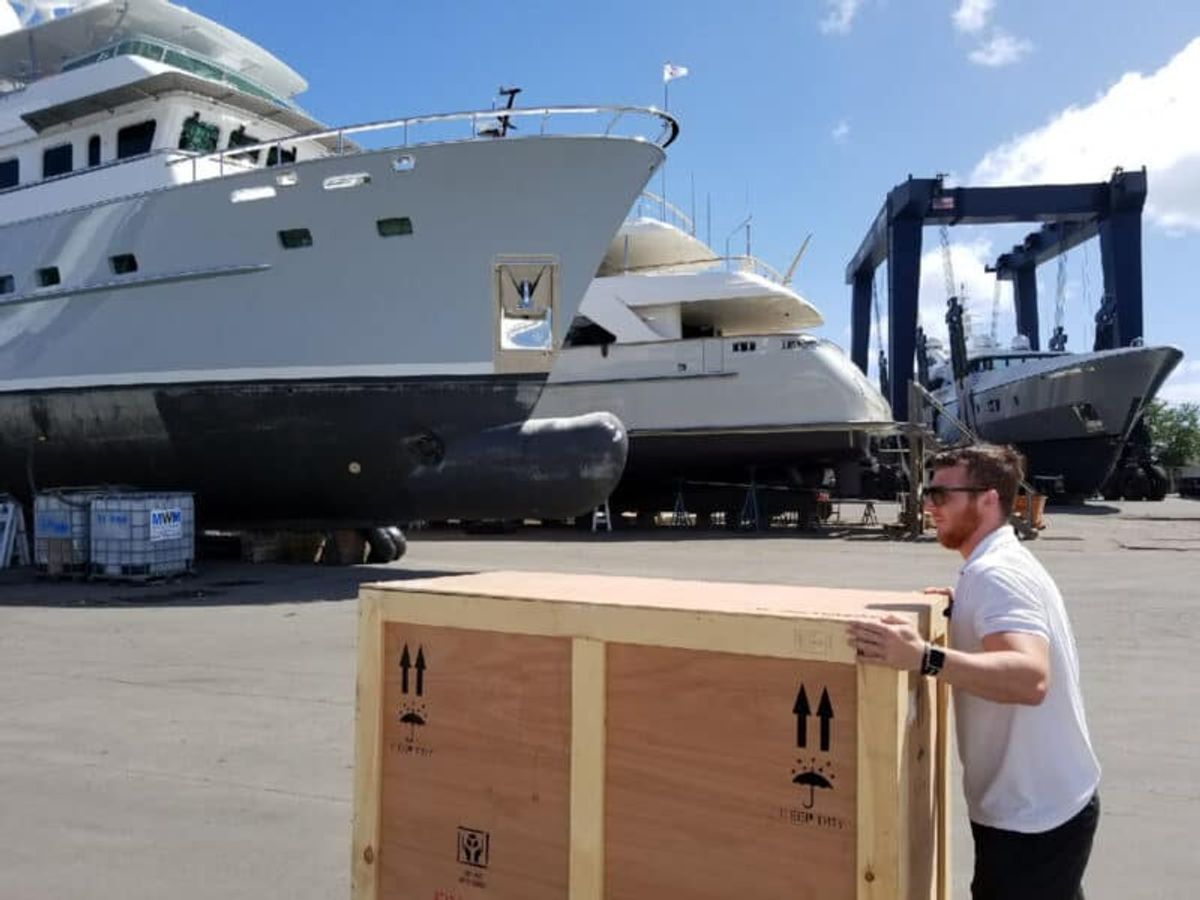
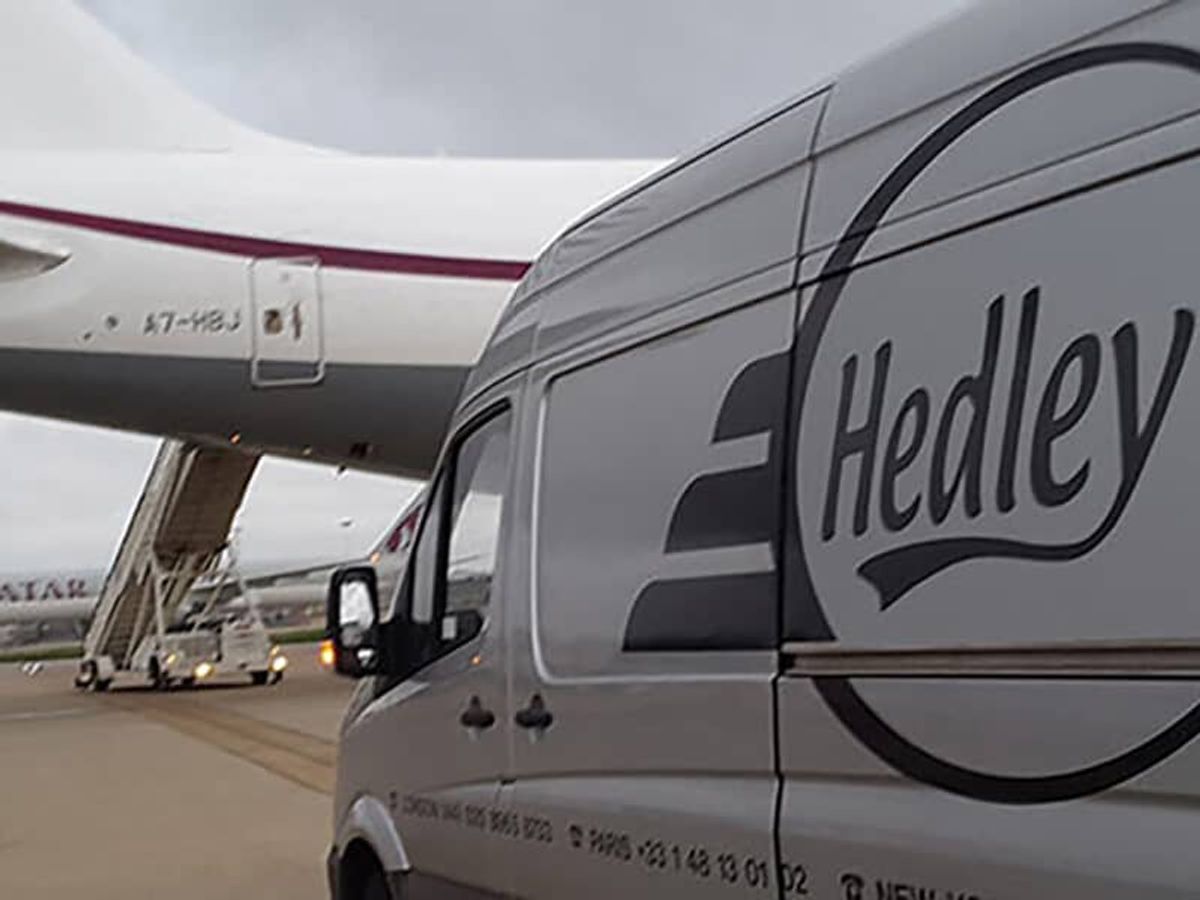
“It would depend on what the safest option is, where the owner is, and every case is really different,” Mather-Lees said. Typically, the art should be moved into specialist fine art freight storage and would require a professional art-handling logistics company to do so, someone like Bellissima in Florida or Hedley’s Group in Europe, which Mather-Lees previously worked for. As Mather-Lees pointed out, “From the security of the conservation of the art stance, and the integrity of the piece itself, the less distance it’s moved, the better.”
Capt. Will Kaye of M/Y Coral Ocean shared that he’s only once moved art ashore during refit, and he hired a specialist art dealer to do so. The art was moved back aboard after the refit was complete.
Some areas surrounding yards have better storage options, but that’s where the yard can help with logistics. You’d need climate-controlled, secure options, which can generally be found in most larger cities. Some ports, Mather-Lees said, have freeports, or you could find similar bonded storage facilities or warehouses.
A free port is a zone considered outside of a country’s customs territory, while a bonded warehouse is considered legally part of the territory. Art stored in a bonded warehouse or free port will not incur customs duties or taxes if the artwork moves only between the vessel and the facility. Make sure to double-check all the local regulations.
Another factor to consider is the vessel’s tax position. “The family office would have to give a holistic view of [the art] and the entirety of the owner’s assets, and whether offboarding pieces in a particular place would put those assets at risk from a tax perspective,” Mather-Lees said.
As Mather-Lees explained, you need to consider all angles because if the yacht owner died while the art was ashore during a refit, it could leave the owner’s family dealing with a very large inheritance tax situation, depending on the location.
Other things to consider are the artwork’s cultural heritage and any export regulations, in the sense that the vessel may be carrying artwork that includes endangered species, which could be a rosewood frame on a painting. Customs will typically confiscate these items if they’re not handled correctly.
The same applies if the work is considered a cultural treasure. A new regulation in Europe, EU 2019/880, was introduced to help eliminate art trafficking, meaning that any archaeological antiquities more than 250 years old or certain other objects with non-EU status over €18,000 require an import license into Europe. This license is very hard to get, Mather-Lees said, because you must prove that the piece was exported legally from its place of origin.
Decoding Insurance
Once you’ve decided where the boat is going and where the art will be stored, you must ensure the insurance is in order.
“It’s a minefield right now when it comes to refits,” Laura Sherrod, director of yacht insurance at Newcoast Insurance Services, said. “I’m not sure that everybody pays attention to what the policy actually says.”
There are also shades of gray swirling about the word refit and what it really means. “We talk about refits a lot in insurance because it’s a big issue,” Sherrod said. “You know, where it transitions from, ‘We’re just going in for a yard period’ to ‘We’re going in for a refit.’ There’s a gray area, and some of the policies really do get very specific about what the difference is. Some policies do not.”
The bottom line is that the captain must notify the insurance company when they’re considering a refit and the scope of that refit. They can sit down with their insurance broker and go through their policy. As Sherrod shares, every single insurance carrier uses different policy language when it comes to refit — in fact, she noted, refit is not even defined in most U.S. policies.
Sherrod agreed with Mather-Lees that the best place for the vessel’s valuables is usually on board, but in a major refit event, they likely would be removed.
“Each underwriter handles the issue of personal effects a little differently, and then the separation of the definitions between ‘Personal Effects’ versus ‘Fine Art’ even more so,” Sherrod said.
While the furniture and fixtures would usually fall under the vessel’s equipment policy, the fine art would fit under the fine art clause, where the artwork would be separately scheduled and insured. Removal and storage would normally be spelled out in this clause.
“It all comes back to the actual wording on the specific carrier’s policy,” Sherrod said. “Some policies include fine art within the personal effects; some policies exclude it. If the carrier covers fine art, they still may have a low limit. Some policies limit fine art to $30,000 until the item is declared and agreed.”
In Kaye’s experience, he once had to take out more insurance for items that were moved off the boat; his other experience was that the removed goods were covered by existing insurance. “It’s just really a case of checking with insurance before you do and see what your policy does include and what it doesn’t,” Kaye said.
McGregor’s Bellissima also offers insurance. The vessel’s insurance company needs to know what’s moving off the boat and details about where it’s going, but if the vessel does not have insurance, she offers a transit and storage insurance policy.
Time to Go
Before the art is removed, take inventory of the artwork on board, to be either completed by the crew or the removal specialists. McGregor recommends the crew take photos of all art as it is usually displayed on board. Note its dimensions, where it’s located, and its value.
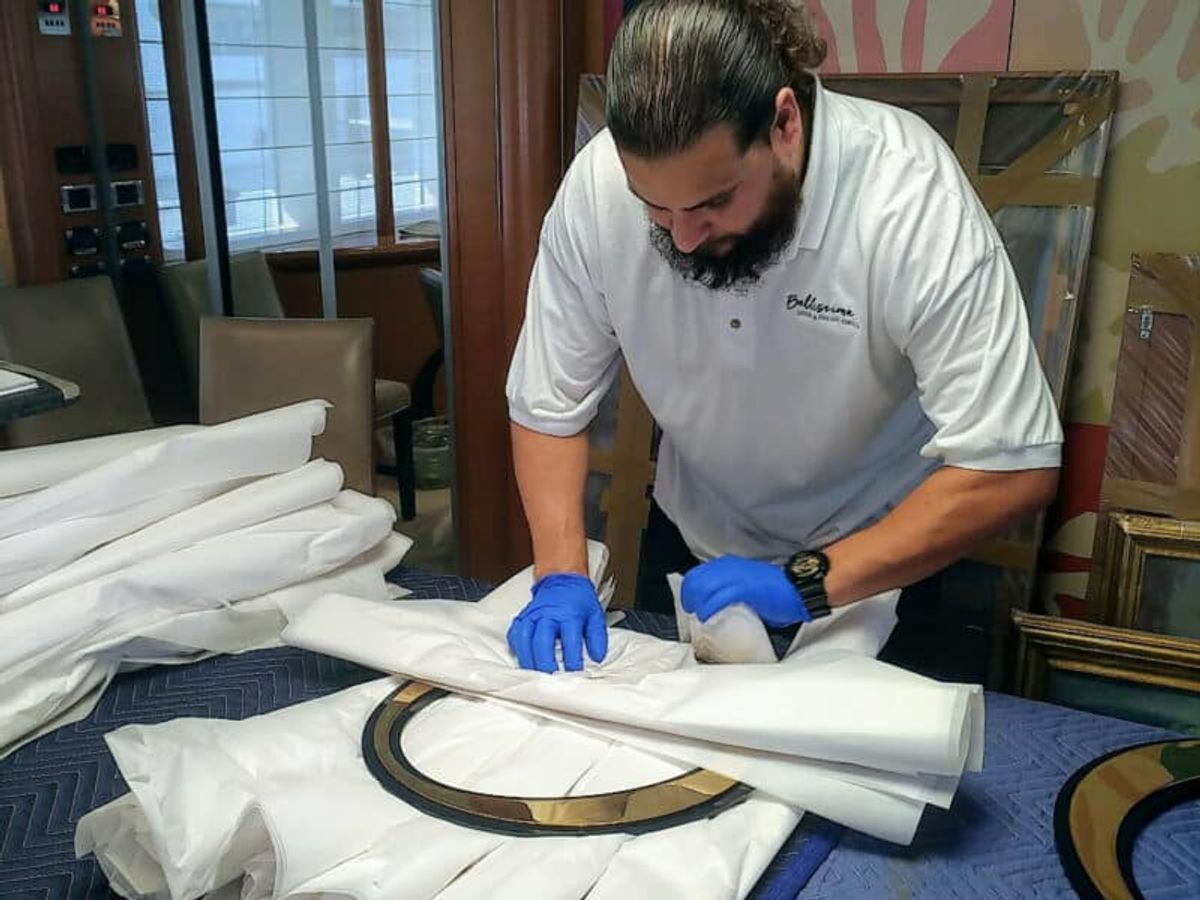
This list is shared with the removal company, like Bellissima. They come aboard, and their trained personnel handle the packing and moving. As each item is packed, it’s tagged, and a condition report is issued, which details how the piece currently appears and notes any damage. This is vital in case there’s additional damage or questions in the process. Both parties usually sign to confirm they agree on the report.
“That’s very important because that owner or client should expect to get their artworks or objects back in the same condition they were when we took them,” said McGregor. “We’re very detailed, and it also gives us and the crew a common document to talk about.”
Having the art ashore in storage might also provide the opportunity to do some conservation work on the pieces. McGregor allows this at Bellissima if permissions are clearly spelled out. McGregor also works with conservators and appraisers that she can recommend. Hedley’s Group sometimes allows this too.
Mum’s the Word
Key to all the chatter about what to do with the artwork is keeping the information quiet when there is a final plan. Between the captain, the family office, the management company, the insurance company, and the shipyard, there are many fingers in the pie. But for security reasons, information about the art must be kept as quiet as possible.
“You only want to have the people know who need to know, so you need to tell enough people that you can get it done safely, securely, on time, and without any hitches, but if you [tell] too many people, there’s a risk you’re going to get hijacked,” said Mather-Lees.
The captain is ultimately responsible for the art, and it should not leave their sight until it’s safely away.
Tips to Clean and Maintain Art on Board
Stews should be trained to clean and maintain the artwork on board. Crew need to understand the value of the work aboard and what the risks are. “A one-day workshop with me could save millions of pounds,” said Pandora Mather-Lees, who offers training sessions for yacht crew on board, in the yard, or wherever is convenient, through her company Art on Superyachts.
“Any cleaning can potentially damage artwork, but it’s unavoidable as crew need to keep things clean,” said Mather-Lees.
She boiled down the basic cleaning tips she recommends to crew:
- Avoid chemicals.
- Use dry methods — dust as opposed to using a wet cloth or wiping with water.
- Use soft brushes regularly to avoid compacted dirt, which may require other removal methods.
- Do not clean in a rush. Take your time.
- Note the artwork’s condition — is it in good condition, or has it been damaged?
- Cover the artwork with a soft blanket when the boat is not in use, if possible.
Every two or three years, the art should be re-evaluated for insurance purposes.
A Stolen Picasso
A Picasso went missing aboard M/Y Coral Ocean (Coral Island at the time) while she was on the dock in Antibes in 1999. The painting, “Buste de Femme (Dora Maar)” from 1938 is worth an estimated $28 million. It was reportedly hanging in Picasso’s home when he died.
Right before COVID, the Picasso was recovered. According to “The Guardian,” it was believed to have changed hands 10 to 20 times, circulating in the Dutch underworld, in the 20 years it was missing.
Although the details of the theft remain a mystery — the captain had stored and locked the Picasso into a stateroom and had the key — a Dutch company contacted Capt. Will Kaye aboard M/Y Coral Ocean and asked if they could attempt a reconstruction of the crime. They brought drones to the area and took images of the vessel in Antibes to attempt to figure out how the theft occurred.