
For many European-built yachts, the original shipyard remains a natural destination when the time comes for a major refit. This pattern has prompted the United States refit sector and yachting stakeholders to ask why so many large yachts choose an overseas yard rather than remain in, or return to, the U.S. for major work. Familiarity with the vessel’s engineering, access to original drawings, and an established relationship with the owner can all make returning to the builder an attractive option. That raises broader questions for the American market: does the same pattern exist among U.S.-built yachts, and could a stronger domestic yacht-building sector create a stronger domestic refit industry?
“Yacht building and refit are closely intertwined industries. Many yacht builders lack the necessary resources to establish refit facilities due to various factors such as geographical constraints, physical plant limitations, personnel shortages, and geopolitical considerations,” said Joe Foggia, founder of Global Yacht Advisors, an independent superyacht advisory firm that supports new construction and build projects around the world.
As Foggia suggests, the relationship between yacht construction and refit is not always straightforward. Builders differ in how they support their vessels during major yard periods after delivery.
Daryl Wakefield, president of Westport Yachts, explained that after brothers Rick and Randy Rust founded Westport and entered the yacht market, the company remained largely focused on new construction rather than on repair and refit.
“I joined in the late ’90s and have been here for 27 years, and it’s only been in the last about 10 years that we did repair,” Wakefield said. “We did warranty work for our new builds, but we never did any refits. In that period, we’ve had probably 10 boats come back for significant refits.”
Westport’s focus on new production was the direction previous ownership had wanted. New ownership is open to refit work, but one challenge makes it difficult: location.
“We’re on the West Coast of the United States, almost into Canada, so it’s not, for the most part, on the way to anywhere,” Wakefield said. “For the guy that wants to see the last frontier of Alaska, we get a shot at them, but the reality of it is, we’re a long way for someone to go from Fort Lauderdale.”
Westport is an example of how an original builder’s knowledge of a yacht can be outweighed by geography and the vessel’s cruising schedule.
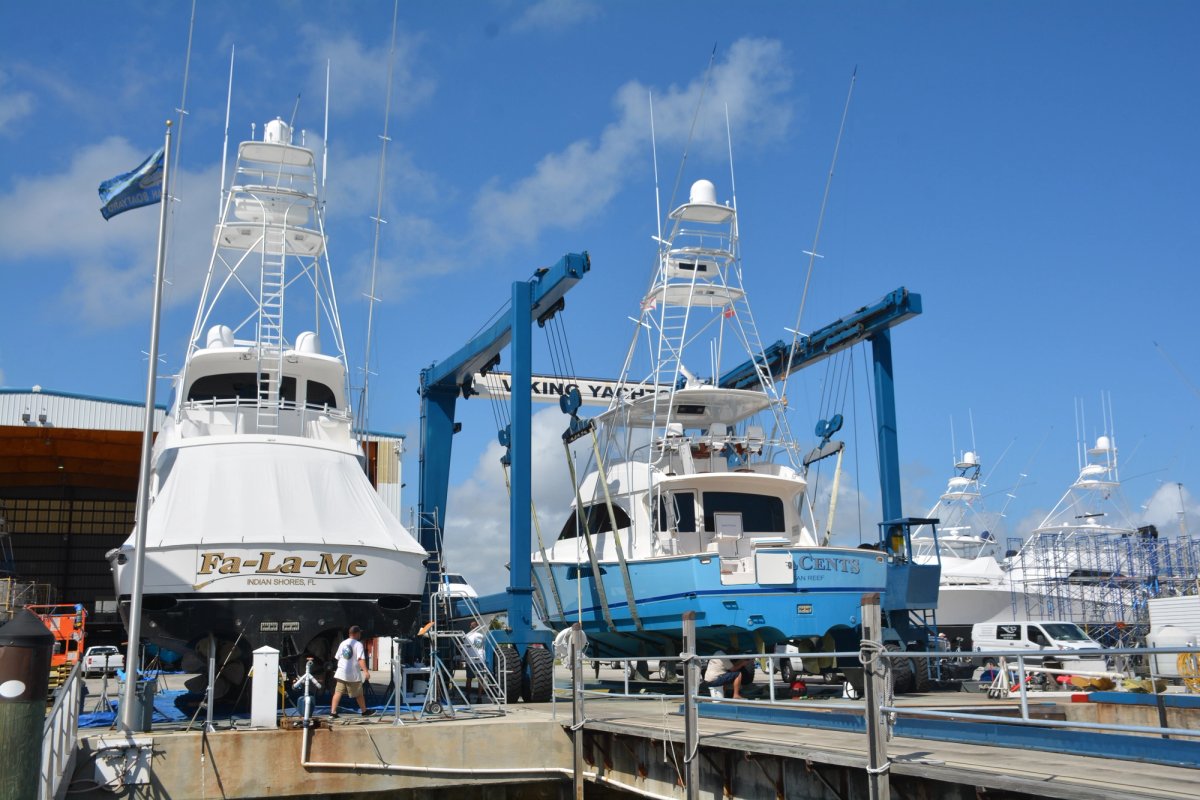
Viking Yacht Company took a different approach. Viking conducted a study 25 years ago to find out where their vessels traveled most, finding that 70% of the Vikings in service at the time, as well as their new boats, passed through Palm Beach Inlet each year. After the study, they built the Viking Yacht Service Center there. Viking has a strong reputation around supporting owners after delivery, and it’s one that was purposefully built.
“It is so important that we have spent close to $50 million on facilities to support warranty work, repairs, and continuous updates throughout the life of the boat,” said Pat Healey, president and CEO of Viking Yacht Company.
Healey estimates that about 95% of the vessels serving the global sportfishing market are from North America, including both inboard and outboard vessels. He agrees that the growth of a domestic yacht-building sector can help create a stronger domestic refit industry, but says the market has changed.
“About 15 years ago, U.S. boatbuilders probably produced 500 inboard boats a year. Today, it is fewer than 100, and Viking represents about 60% of that production,” Healey said. “The major growth has been in outboard boats. Today, there are about 15 U.S. outboard builders producing anywhere from 125 to 250 boats annually. The service and refit industry must adapt to support that growing fleet.”
Healey’s figures suggest that the domestic market is changing rather than disappearing, with outboard-powered boats on the rise. Wakefield agrees the market is changing, but is worried about what it means for the traditional yacht-building sector.
“I don’t believe U.S. yacht building is growing — I believe it’s shrinking,” Wakefield said. “I hate saying it, but that is the truth. There are fewer of us every year, and I don’t know if that’s going to continue, but I don’t see anybody new coming along saying, ‘Let’s start a boatyard.’”
The growing outboard-powered fleet is one opportunity for the U.S. refit sector, but large custom yachts require a different level of infrastructure. Deep-water access, greater haul-out capacity, and facilities capable of accommodating vessels now regularly 60 meters and above are needed. Phil Purcell, CEO and president of the Marine Industries Association of South Florida, argues that the issue is not a lack of American technical expertise. He points to companies like Quantum Marine Stabilizers, DeAngelo Marine Exhaust, Ward’s Marine Electric, National Marine Suppliers, and others as examples of American expertise operating around the world and servicing yachts. Instead, he believes the domestic refit market needs more physical capacity to service larger yachts.
“Where are we going to service 70-meter plus boats, because most of those boats are U.S.-owned,” Purcell said. “We have to look at the Fort Pierces of the world, we have to look at assembling enough property at Dania Cut.”
Purcell highlighted RMK Merrill-Stevens’ aggressive expansion plan in Miami as something that should be happening more and more. To accomplish it, Purcell says yards have to come together with plans for economic backing too.
“You need someone like a Ken Griffin, a Sergey Brin, and a David MacNeil to put their heads together, get the operational expertise of a Bradford or Derecktor, and build a facility that can service the boats that the American consumer has gone and built overseas,” Purcell said.
Physical capacity may not be the industry’s only challenge. Wakefield believes the U.S. has also struggled to communicate the employment and economic activity generated when a large yacht enters a domestic yard.
“All too many people have a voice and feel that these horribly rich people shouldn’t be allowed to have these luxurious boats,” Wakefield said. “Instead of actually looking at the reality and saying, ‘My God, this is a 100,000-hour refit,’ and counting the bodies that are working and the paychecks that are going home. We haven’t done a very good job in the United States of highlighting that.”
That perception contrasts with parts of Europe where yacht construction and refit are more readily viewed as a well-paid, highly skilled industrial activity, according to Wakefield. The U.S. sector may not only need more dedicated refit facility space to compete for major work, but also a stronger explanation of why keeping that work domestic matters.
Foggia agrees, saying shipyards should establish vocational resources for the upcoming generation. From an owner’s perspective, Foggia says factors influencing the choice of a refit yard include the project’s scope, the yacht’s cruising schedule, the yard’s financial stability, and the owner’s ability to oversee the work. He generally recommends returning to the original builder or one of its designated facilities for yachts exceeding 60 meters.
“Unfortunately, other non-builder refit yards, despite their qualifications, have uncertainties as their caveat, resulting in more favorable initial pricing,” Foggia said. “However, the final pricing is typically considerably higher.”
Westport and Viking’s experiences suggest there is no single return-to-builder pattern for U.S.-built yachts — and there likely isn’t one in Europe either. Instead, owners are more likely to return when a builder has created a service network and made long-term support part of its after-sales service model. When that model doesn’t exist, geography, cruising schedules, yard capacity, and project risk can outweigh the original builder’s familiarity with the vessel.
A stronger U.S. yacht-building sector could help generate more domestic refit work by expanding the U.S. fleet, but construction alone can’t guarantee that the work will stay in the U.S. Instead, strengthening relationships between builders and refit yards, larger facilities, and continued investment in skilled labor must continue to compete with Europe.
Image by Viking Yacht Company.