
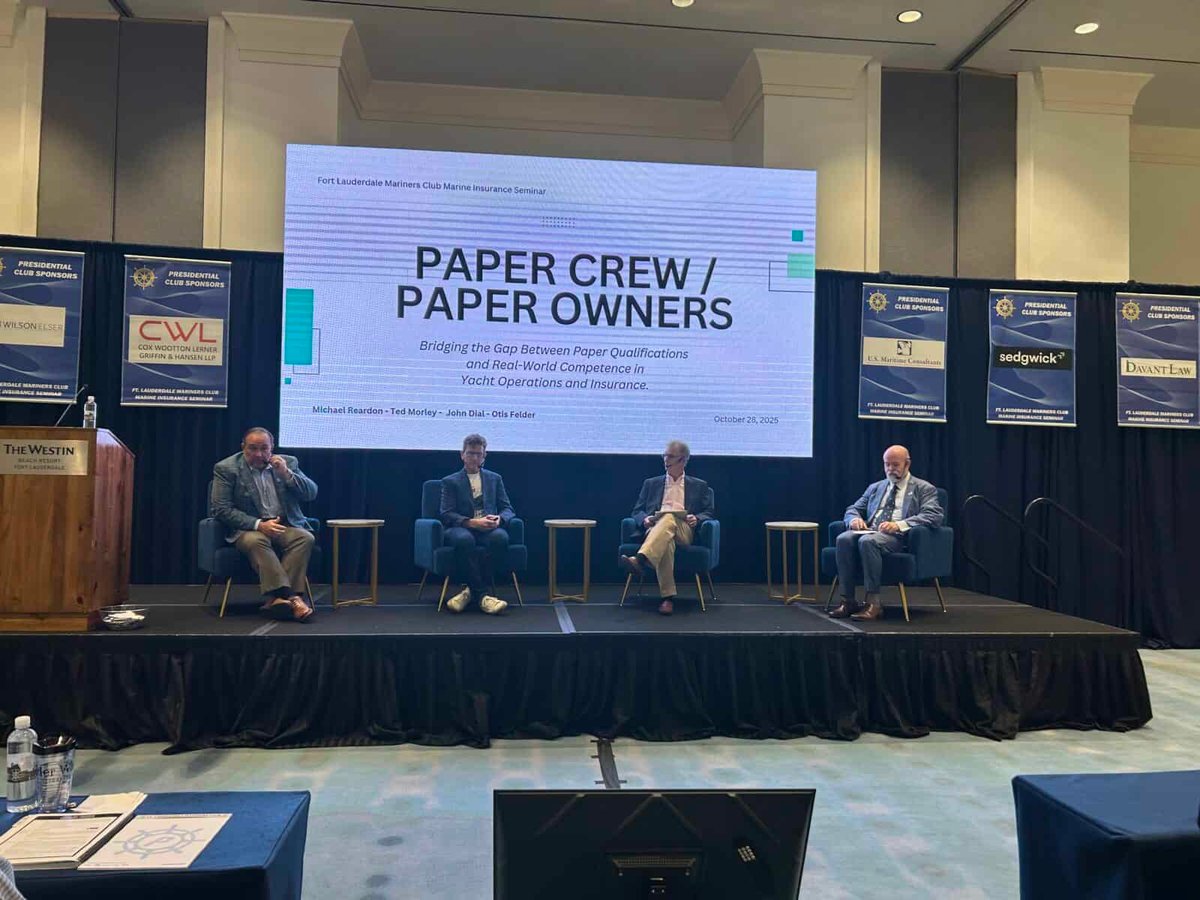
What happens when the paperwork is perfect, but the performance isn’t? Capt. Ted Morley of Maritime Professional Training, Michael Reardon of Reardon Yacht Consulting, John Dial of At the Helm Training, and Otis Felder of Wilson Elser Moskowitz Edelman & Dicker LLP shared their thoughts during the 35th annual Marine Insurance Seminar by the Fort Lauderdale Mariners Club on Tuesday, Oct. 28.
Credentials and compliance records have never looked stronger in the digital world. Yet we continue to see incidents where certified crew and audited operations fall short.
“In the long run, you have to make sure your qualifications are valid, the paper trail is real, and the person that is submitting them to you is actually legitimate,” Morley said.
Morley shared an example of a Port State Control inspection that discovered more than 3,000 false documents in their system. The rise of artificial intelligence is making it easier to falsify documents, but Felder has a possible solution.
“Something we might see is this idea where we use blockchain or some other verification method,” Felder said. “The vessel itself, the vessel owner, or crewmembers can trace back and see where that document came from.”
While the perfect solution for verifying digital credentials is yet to be found, Dial’s answer to the problem is simple: test people based on what their paperwork indicates they can do. Dial receives check ride forms from various insurance companies, often requesting a minimum of 50 hours of evaluation time on the water.
“On an eight-hour day, I’m only giving you four hours — two hours getting ready, one hour ride along with you on the boat hearing about every girl you dated in high school, and an hour pulling the boat back in and doing the checks,” Dial said. “We really get it down to real time of what you’re learning on board.”
While digital credentials and an impressive resume can be very useful for crew, real-world experience still remains the most important for safety and success in the industry.
“Drills, practice, certification, all can lead to better outcomes and positive case studies,” Reardon said.