
From the Great Barrier Reef and the Kimberley’s remote coastline to Sydney Harbour and Tasmania’s cool-climate wilderness, Australia offers superyachts four dramatically different cruising experiences within one country.
At nearly the size of the contiguous United States, Australia’s coastline spans tropical reefs, remote river systems, major cities, and cool-climate wilderness. A yacht cruising the country’s northern reaches can encounter a completely different landscape than one cruising its southern coast. That scale allows Australia to offer different styles for different yachting tastes.
The Whitsundays and the Great Barrier Reef offer tropical island-hopping, while the Kimberley offers expedition cruising through one of the country’s most remote regions. Sydney combines one of the world’s most recognizable harbors with restaurants, nightlife, and events, while Tasmania swaps tropical waters for rugged coastlines, hiking, food, and wine. For yachts making the trip Down Under, these four regions show just how varied an Australian itinerary can be.
The Whitsundays and Great Barrier Reef
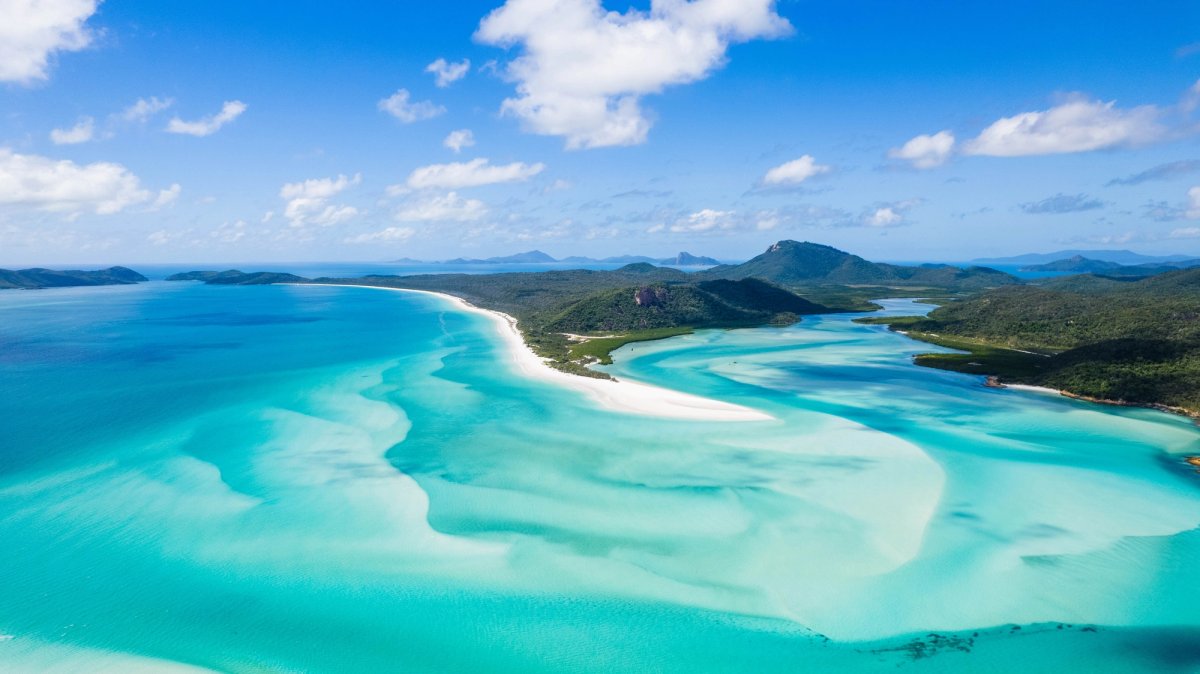
The 74 Whitsunday Islands are surrounded by Great Barrier Reef waters and create Australia’s “conventional luxury-yacht destination.” The ability to alternate between beaches, reefs, secluded anchorages, and developed resort facilities makes it a prime yachting destination. While Whitehaven Beach and its white silica sand is one of the region’s best-known attractions, a yacht offers access to more of the area. Days can be spent snorkeling or diving the Great Barrier Reef, exploring islands by tender, or viewing the reef from a helicopter before returning to secluded anchorages.
Hamilton Island provides restaurants, accommodations, a golf course, and an airport alongside its marina. Hamilton Island Marina accommodates vessels up to 45 meters. Larger yachts can head to Coral Sea Marina in Airlie Beach, where the 520-berth marina can accommodate vessels up to 80 meters.
While recreational superyachts generally do not need a Marine Parks permit, commercially operating superyachts do. Yachts over 35 meters generally have designated anchorage requirements in parts of the reef. Vessels over 50 meters participate in ReefVTS, which provides shipping traffic information, navigational assistance, and maritime safety information to aid on-board decision making. Vessels 70 meters and above require a licensed coastal pilot in designated compulsory pilotage areas.
The Kimberley
If the Whitsundays are like a traditional yachting destination, the Kimberley is closer to an expedition. Western Australia’s Kimberley is less about resort hopping and more about what a yacht can reach when there are few resorts at all. Red sandstone cliffs, river systems, waterfalls, mangroves, and more than 1,000 islands within the Buccaneer Archipelago shape the coastline. Farther north, King George Falls drops between towering cliffs, while Montgomery Reef transforms with some of the region’s enormous tides. These tides influence where and when yachts and tenders can operate, making local knowledge an important part of a Kimberley itinerary.
Yachts traversing the area will find gateway ports instead of conventional superyacht marinas. The Port of Broome has commercial marine infrastructure. Wyndham is useful at the northeastern end and is the only deep-water port between Broome and Darwin. Derby is another working port in the Kimberley.
Sydney and New South Wales
A yacht entering Sydney Harbour passes two of Australia’s most recognizable landmarks, the Sydney Opera House and Sydney Harbour Bridge, before reaching its waterfront restaurants, beaches, and one of the country’s largest cities. Captains and crew can use the major global city as a reset. Provisioning, spare parts, medical care, contractors, gyms, international flights, and plenty to do ashore are all available after a long cruising itinerary. New Year’s Eve gives yachts a front-row view of Sydney’s famous fireworks, while the annual Rolex Sydney Hobart Yacht Race begins in the harbor every December.
Sydney Superyacht Marina in Rozelle Bay provides berthing for yachts up to 75 meters and Med-style berths for vessels up to 50 meters. Jones Bay Superyacht Marina offers deep-water berthing for yachts from 20 to 100 meters. Cruising north, yachts can find Pittwater, Broken Bay, and the Hawkesbury River, changing an urban itinerary to one that offers national parks, secluded bays, waterfalls, and bushland.
Tasmania
More than 500 nautical miles south of Sydney, Tasmania offers another change of scenery. The country’s southernmost state features granite mountains, sea cliffs, secluded beaches, and cooler waters. Opportunities for hiking, kayaking, and wildlife viewing ashore are available on the Freycinet Peninsula, Bruny Island, and the Tasman Peninsula. Bruny Island and the D’Entrecasteaux Channel are famous for their seafood, oysters, cheese, and other Tasmanian produce, making them a key stop in Tasmania.
Hobart acts as a base for yachts, with The Royal Yacht Club of Tasmania offering berthing for visiting vessels primarily in the 10- to 20-meter range, but it also makes temporary arrangements for larger vessels. Prince of Wales Bay Marina has 350 floating berths, accommodating vessels up to 40 meters. Hobart is also an Antarctic gateway.
Before Arriving Down Under
Before a yacht reaches Australia’s cruising grounds, captains and crew must prepare for Australia’s customs, immigration, and biosecurity requirements for vessels arriving from overseas. Private yacht captains are generally required to notify the Australian Border Force at least 96 hours before arrival. The yacht must make its initial arrival at an approved port of entry unless prior permission has been granted. Everyone on board must have the appropriate passport and visa, and crew and guests cannot go ashore until the vessel receives the necessary border and biosecurity clearance.
Non-commercial yachts entering Australia must submit an electronic Pre-Arrival Report no more than 90 days and no less than 12 hours before arrival. The report provides authorities with information about the vessel’s voyage history, people on board, food and other goods, plants and animals, waste management, and the yacht’s cleaning and biofouling history. Once submitted, authorities issue a Biosecurity Status Document outlining any vessel requirements or directions.
New proactive biofouling-management requirements for non-commercial vessels took effect on June 17, 2026. Captains must provide information on how biofouling has been managed. For captains coming south from Asia or crossing the Pacific, visas, arrival reporting, onboard provisions, and hull-cleanliness records should all be addressed well before the Australian coastline appears on the horizon.