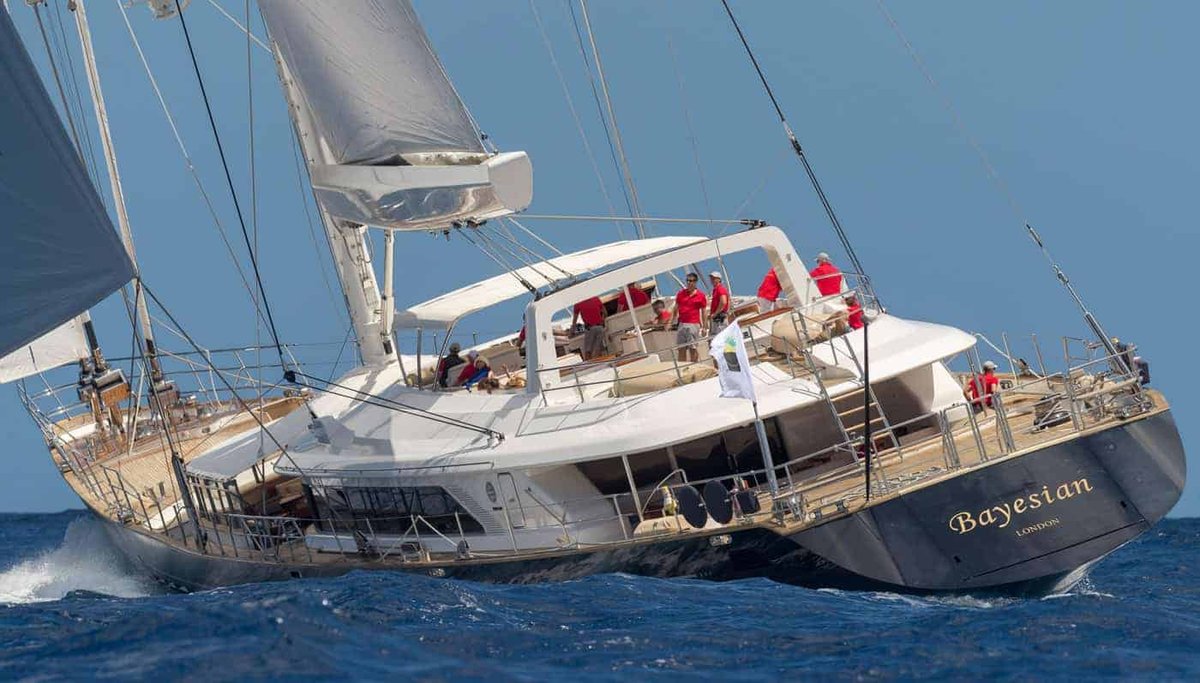
The Marine Accident Investigation Branch (MAIB) released an interim report on the circumstances of the loss of seven lives after S/Y Bayesian capsized on Aug. 19, 2024, 0.5 nautical miles southeast of Porticello, Italy. While still working on a final report, MAIB released a “desktop” assessment of Bayesian’s capsizing based on available documents and information that will be validated, and if necessary, iterated and improved following detailed examination of the wreck once it is salvaged. With that stated, there is a possibility that new evidence may alter some of the circumstances in their report.
What Happened
MAIB initiated a safety investigation into the loss of Bayesian following the accident, but its access to the wreck and other material elements of primary evidence have been restricted due to a criminal investigation being led by the Termini Imerese Public Prosecutor’s Office, Sicily, Italy. MAIB’s investigation details the sequence of events that led to Bayesian capsizing, beginning with the yacht moving from Cefalù towards Porticello to anchor for the night, shelter from the forecasted weather, and allow for easy disembarkation of guests the next day. Bayesian anchored at 2124 with its centerboard in the raised position, with S/Y Sir Robert Baden Powell at anchor nearby.
Thunderstorms had been forecasted for the night, with Bayesian’s skipper instructing two deckhands conducting an overnight watch to wake the skipper if the wind speed increased above 20 knots or if there were signs the yacht was dragging anchor. At approximately 0355, one of the deckhands videoed the advancing storm and posted it to their social media feed. The deckhand then went onto the deck and closed the forward hatches and cockpit windows to protect the yacht’s interior from rain, noting that the wind had picked up to 30 knots and was broad on the port bow. The yacht was now listing to starboard, and the deckhand thought the vessel was dragging its anchor, according to the report.
Two minutes later, at 0357, both Bayesian and Sir Robert Baden Powell were dragging anchor in rapidly worsening weather. The deckhand ran below to wake up the skipper three minutes later, with the yacht’s chief engineer, chief officer, chief steward, chef, and stews awakening around the same time as well. At this time, the yacht was estimated by those on board to be listing between 10° and 20° to starboard. Some of the crew began securing loose items while three guests, including a baby, arrived in the saloon.
As the skipper began to maneuver Bayesian up into the wind, the wind suddenly increased to more than 70 knots, causing the yacht to heel over to 90° to starboard, taking less than 15 seconds to do so, according to the report. One of the deckhands was thrown into the ocean by this, while multiple crew, the owner, and a guest were injured by falling or from things falling on them. Two guests used furniture drawers as an improvised ladder to escape their cabin, using the internal walls to get into the saloon area. Water came in over the starboard rails and entered the internal spaces down the stairwells within seconds.
Fifteen people escaped the yacht, while six guests and one crewmember died. Crew from Sir Robert Baden Powell helped gather the survivors with their tender and searched for any other survivors at 0443.
The Environment
MAIB’s investigation also examined weather forecasts for the period, actual weather observations from the night of Aug. 18/19, 2024, and evidence from local closed-circuit television footage and witness testimony. Multiple weather forecasts predicted thunderstorms and gusts, while winds were recorded to have suddenly increased from around 5 knots to 41 knots from the northwest about five nautical miles to the northwest of the Porticello anchorage.
The investigation commissioned the Met Office, the United Kingdom’s national meteorological service, to analyze the weather conditions. The study concluded that a trough of lower pressure transited the area overnight, noting that local data stated there was a large amount of convective available potential energy in the atmosphere. Sufficient wind shear was evident, and conditions were borderline for the development of supercells. The study concluded that a mesocyclonic storm was highly likely with an associated supercell being probable. It concluded that tornadic waterspouts and downdrafts were possible as well.
The Vessel’s Stability
MIAB’s investigation used Bayesian’s approved stability information booklet (SIB) from when it was built to investigate the vessel’s curves of statical stability for specific loaded conditions. It also used the SIB to investigate the vessel’s “curves of maximum steady heel angle to prevent downflooding in squalls,” which provides a safe operating range for a sailing vessel, indicating the maximum heel angle it could withstand before there was a risk of downflooding occurring in a sudden gust or squall, according to the report.
“The SIB did not contain such curves for when Bayesian was operating in the motoring condition where the centreboard was raised and no sails were up,” the report stated.
The investigation commissioned The University of Southampton’s Wolfson Unit for Marine Technology and Industrial Aerodynamics (Wolfson Unit) to build a stability model for Bayesian that replicated the information contained in the SIB.
“The stability model was subsequently adjusted to replicate the assumed loss condition; assessed as being similar to the motoring condition, with the centreboard raised and in the loaded arrival state (with 10% consumables on board),” the report stated. “The study determined that the angle of vanishing stability in this condition was 70.6°.”
While the study found that if the vessel heeled to an angle greater than 70.6° there was no chance of a return to even keel, it also found that wind speeds in excess of 63.4 knots on the beam were sufficient enough to knock Bayesian over, in the assumed loss condition. It is also possible the yacht was similarly vulnerable to winds less than 63.4 knots, according to the report.
These vulnerabilities were not identified in the stability information book carried on board, making it a complete unknown to the owner or the crew of Bayesian, according to the report. The investigation indicated a probable transient presence of hurricane force winds more than 64 knots at the time of the accident, reaching a speed sufficient to knock Bayesian over.
“Examination of the wreck of the yacht, when salvaged, should improve the investigators’ understanding of the yacht’s actual loss condition, including its loading, deadweight carried, downflooding points and the position of the centreboard, in order to validate or improve the theoretical assessment already conducted. A fuller understanding of the access and egress routes, internal layout and liferaft status will enable the investigation to reach safety conclusions related to survivability,” the report stated. “Until the investigative work is complete, and the final report published, the contents of this interim report should be taken as indicative of the circumstances of the accident.”
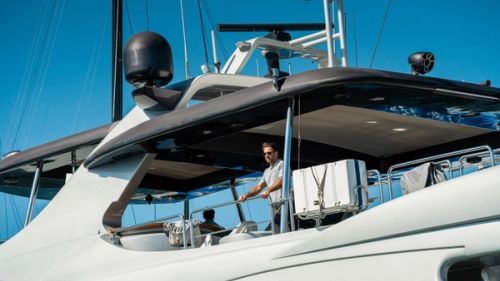
Image by Perini Navi.