

As yachts become increasingly technologically advanced, crew expectations are evolving beyond traditional seafaring roles.
What should crew understand about which skills will matter most?
The Engineer’s Role
Few departments are changing as rapidly as engineering. While mechanical expertise remains essential, modern yacht engineers are increasingly expected to manage complex electrical systems, digital networks, onboard data, and remote diagnostics alongside traditional maintenance duties.
Artificial intelligence (AI) and automation tools are increasingly shaping the role. “It’s less the dramatic ‘AI takes over the engine room’ narrative and more a steady augmentation of what the engineer already does,” said Sam Wheaton, a former yacht engineer who launched Seahub with Engineer Matthew Hyde.
“Today, engineers are increasingly systems engineers responsible not only for mechanical servicing but also for the data and software systems that tie it all together,” Wheaton said. He noted that connectivity tools like Starlink have transformed diagnostics, remote OEM support, firmware updates, and digital maintenance management — capabilities he only dreamed of 15 years ago — while engineers are also expected to manage significantly more onboard data and digital systems than in the past.
“Starlink and the wider connectivity landscape also need to be understood at a practical level — because when connectivity drops, a surprising amount of the modern yacht degrades with it,” he said.
Wheaton recommends aspiring engineers focus on electrical systems — particularly large-scale DC systems such as battery and inverter technology. Networking fundamentals are also increasingly important, as is data literacy: the ability to recognize trends and distinguish developing faults from normal operational noise.
Wheaton recommends additional skills in network literacy, data analysis, software tools, and sufficient hydraulic and refrigeration knowledge to troubleshoot those systems. While the ETO may handle some of those, Wheaton notes that well-rounded engineers should understand all aspects.
Chief Engineer Alex Pujol also emphasized the importance of networking, troubleshooting, and electrical knowledge, along with a strong understanding of automation, noting that engineers today must be comfortable diagnosing a wide range of onboard systems in an increasingly complex engine room.
“In yachting, the last thing you are is an engine guy,” Pujol said. “IT and networking are huge — not only for communication but also for navigation. You don’t have to be a programmer, but you do need a basic understanding.”
He encourages engineers to pursue manufacturer training, stay curious, keep learning, and develop the self-reliance to solve problems independently. “Have an open mind,” he said. “Don’t be afraid to ask questions and gain knowledge about everything.”
“Hands-on experience still wins,” Wheaton said. “The old adage rings true — you learn more from a vessel that breaks down often than one that doesn’t. A season or two on a busy vessel builds a depth of troubleshooting instinct that will serve you well throughout your career. Core mechanical competence still matters. A diesel engine is still a diesel engine, and that skillset can’t be shortcut.”
The Deckhand Role
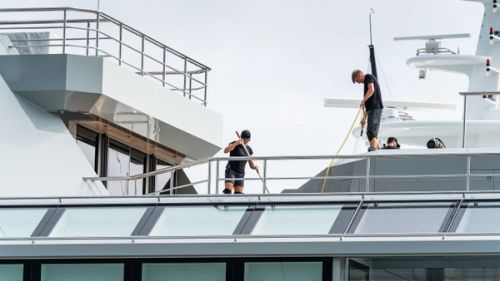
On deck, the traditional deckhand role still includes washdowns, polishing, line handling, tender driving, watersports, and maintaining the yacht’s exterior. However, today’s deck crew are increasingly expected to move between seamanship and guest-facing responsibilities.
“While those skills still matter, modern yachts now place far greater emphasis on guest interaction, water sports, technology, and overall experience delivery,” said Cara Lees, founder of Cara Lees Yacht Crew in the UK.
Marcy Williams, director of crew services at Northrop & Johnson, agreed, noting that expectations surrounding how those duties are performed have evolved significantly. Increasingly, deckhands are expected to act as instructors, guides, or even content creators.
Williams noted that additional skills such as fishing, diving, videography, drone operation, social media content creation, and tender driving can help crew stand out. New tenders and water toys are also flooding the market, increasing demand for deck crew experienced in operating them. “The new toys are very popular, and deckhands who can use these toys properly are ahead of the game,” Williams said.
“The industry is far more competitive than it used to be, so investing in additional skills can really help you stand out,” Lees said. “At the same time, don’t overlook the importance of traditional seamanship and professionalism.”
Williams said more captains are requesting AEC 1 and 2, as well as RYA Powerboat Level 2. Lees agrees that STCW, ENG1, and, ideally, a Powerboat Level 2 should be the basics, but she also notes that diving, jet-ski instruction, watersports operations, first aid, tender driving, and drone certifications are increasingly valuable. Chantelle Crofton of Venture Yacht Crew agrees and has also noticed that AEC 1 and 2 are becoming more common; she said carpentry skills and handling large tenders are always useful.
“Guest expectations have become far more experience-driven, so personality, adaptability, and presentation now play a much bigger role than they once did,” Lees said. All agents agree that attitude is crucial. “Focus on attitude just as much as qualifications,” Lees said. “Be willing to learn, work hard, and stay adaptable.”
“Be career-minded,” Williams said. “Gain longevity and DO NOT BOAT HOP. With each move from one short stint to another, it will be harder and harder to get a good full-time job.” Crofton echoed the call for longevity, recommending that crew try to stick out a job as long as possible.
“For crew wanting to stay competitive long-term, developing practical seamanship skills alongside guest-facing experience remains essential,” Lees said.
As yachts continue to evolve, adaptability may become the most valuable skill of all.