
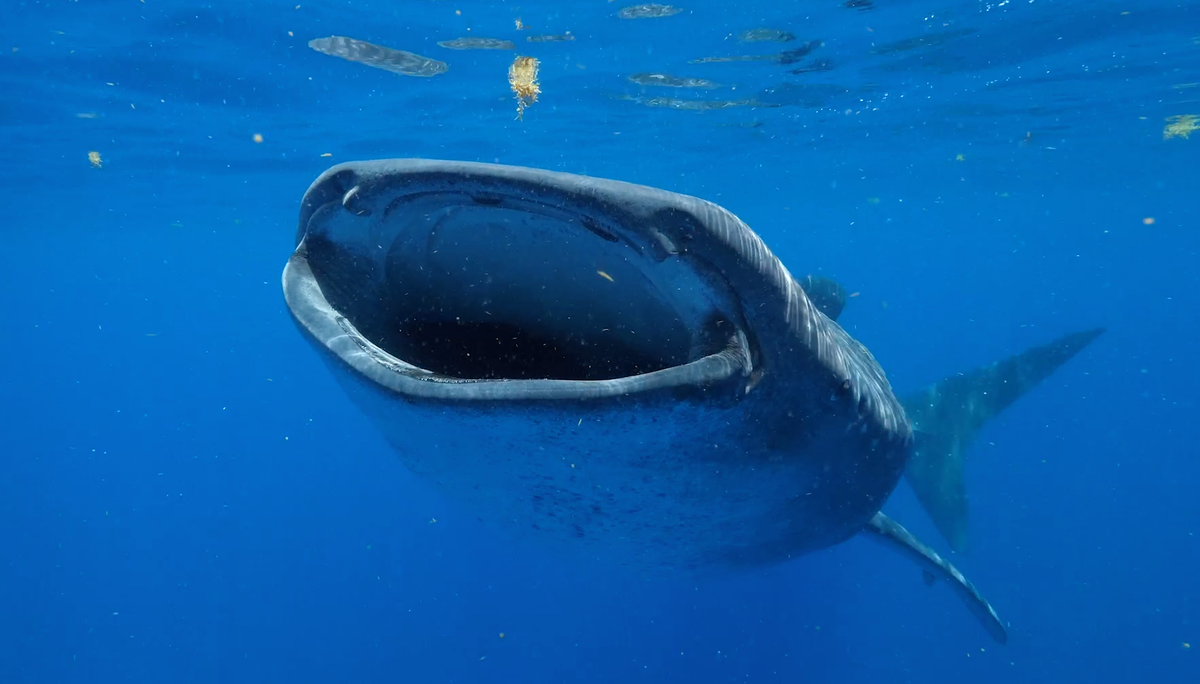

Researchers have tracked a whale shark named Milo for more than 34,000 miles over nearly a decade, which has offered an exceptional look at the movements and habitat use of one of the ocean’s largest and most elusive marine creatures. The nearly decade-long effort represents the longest documented record of a shark’s movements, according to the research team.
The Guy Harvey Foundation partnered with the Mexican conservation organization Ch'ooj Ajauil AC, Nova Southeaster University, and the University of Rhode Island for the tagging operation.
Milo has returned regularly for almost 10 years to the annual whale shark aggregation off Mexico’s Yucatan Peninsula. Researchers first tagged him in 2017, but the tag transmitted data for only a few weeks while the team continued refining its tagging methods. Since then, Milo has been fitted with fin-mounted satellite tags in 2018, 2020, 2023, and July 2026.
The tags have recorded extensive movements throughout the Gulf of Mexico and the northern Caribbean, as well as areas east of Bermuda and as far north as Massachusetts.
“Long-term studies like these are critical to better understanding the complete life history of these long-lived animals,” says Dr. Guy Harvey, founder and chairman emeritus of the Guy Harvey Foundation and founder of the Guy Harvey Research Institute (GHRI) at Nova Southeastern University. “Being able to retag an individual animal five times and follow it for almost a decade is unprecedented and will provide tremendous information to better understand and conserve this endangered species.”
Milo is a large sub-adult male measuring more than eight meters in length. Researchers can identify individual whale sharks by their unique spot patterns and dorsal fin shapes, allowing them to track the same animals over time.
Whale sharks are the largest fish in the sea and can reach more than 60 feet in length. Although generally solitary, they congregate seasonally in areas with abundant food. Each summer, whale sharks and manta rays gather off the Yucatan Peninsula to feed on fish eggs and larvae at the ocean’s surface. In 2026, hundreds of whale sharks and manta rays have been observed at the site daily after lower numbers in recent years.
“These sharks are clearly equally at home in the far offshore deep ocean as they are in shallow coastal areas, despite how different those environments are,” says Dr. Mahmood Shivji, director of GHRI.
Since 2017, the research team has deployed 48 fin-mounted satellite tags on whale sharks in the region to study their migration patterns and habitat use. The International Union for Conservation of Nature classifies whale sharks as endangered, and threats include overfishing and vessel strikes.
GHRI research has also indicated that whale sharks can live for more than 125 years, and data from satellite-tagged animals like Milo can help identify key habitats and migration routes, supporting species’ conservation efforts.
GHRI researchers study the migratory patterns, genomes, and other characteristics of numerous marine species, including whale sharks, tiger sharks, mako sharks, oceanic whitetips, marlin, and sailfish. Milo’s track, along with those of other tagged animals, can be viewed on the institute’s online tracking platform.